
Circumcision
Overview
Circumcision is a surgical procedure that removes part or all of the foreskin (prepuce), the fold of skin covering the glans (head) of the penis. It may be performed for medical, functional, cultural, religious, or personal reasons.
For adults, circumcision is commonly recommended to treat conditions such as phimosis, recurrent infections, chronic inflammation, or recurrent tearing of the foreskin. Others choose circumcision to improve hygiene, comfort, or the appearance of the penis.

What Conditions Can Circumcision Treat?
Circumcision may be recommended for several medical conditions, including:
-
Phimosis (tight foreskin)
-
Recurrent balanitis (inflammation of the glans)
-
Recurrent posthitis (inflammation of the foreskin)
-
Balanoposthitis (combined inflammation)
-
Recurrent urinary tract infections in selected patients
-
Recurrent tearing or scarring of the foreskin
-
Chronic irritation
-
Certain benign skin conditions affecting the foreskin
-
Paraphimosis (following emergency treatment)
It may also be chosen for cosmetic, hygienic, cultural, or religious reasons.
Who May Be a Candidate?
A consultation may be appropriate for men who:
-
Have persistent phimosis
-
Experience recurrent infections
-
Have recurrent inflammation or irritation
-
Develop painful foreskin tearing
-
Have experienced paraphimosis
-
Prefer a permanently exposed glans
-
Desire cosmetic improvement
-
Wish to undergo circumcision for personal, cultural, or religious reasons
A consultation helps determine whether circumcision is the most appropriate treatment or whether conservative options may be effective.
Understanding the Foreskin
The foreskin is a specialized fold of skin that normally covers and protects the glans penis.
It consists of:
-
Outer skin
-
Inner mucosal lining
-
Blood vessels
-
Nerves
-
Connective tissue
The foreskin is attached to the underside of the glans by the frenulum, a small fold of tissue that may be preserved or modified depending on the patient's anatomy and surgical goals.
At the base of the glans lies the corona, which forms the natural ridge separating the glans from the penile shaft.
During circumcision, the foreskin is carefully reshaped and removed while preserving healthy tissue and maintaining the natural contour of the penis.
Surgical Technique
Adult circumcision is performed under local anesthesia with sedation or general anesthesia, depending on the patient and surgical plan.
After anesthesia is administered:
-
The foreskin is carefully measured
-
The desired amount of skin removal is planned
-
The foreskin is excised with meticulous attention to symmetry
-
Small blood vessels are sealed
-
Fine absorbable sutures are placed to close the incision
The procedure generally takes 30 to 60 minutes.
Most patients return home the same day.
Before
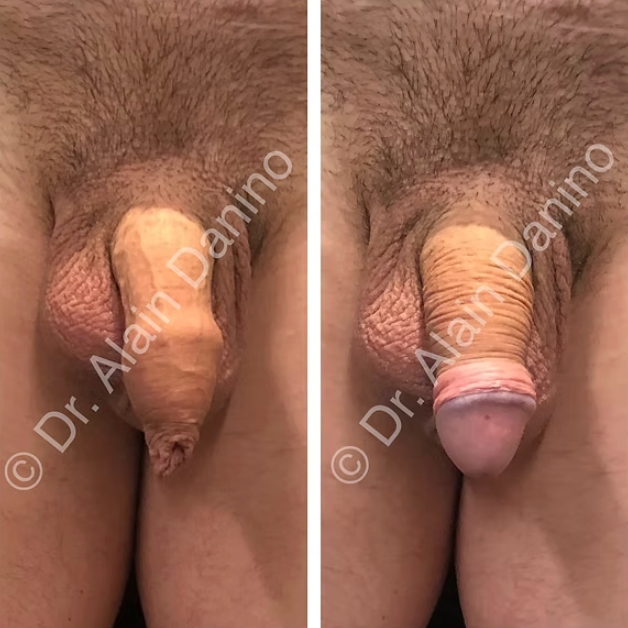

After
Recovery
Recovery is generally straightforward.
Patients are usually advised to:
-
Return home the day of surgery
-
Wear supportive underwear
-
Keep the area clean and dry
-
Apply prescribed ointment if recommended
-
Avoid strenuous exercise for approximately 2–3 weeks
-
Avoid sexual activity and masturbation for approximately 4–6 weeks
-
Attend scheduled follow-up appointments
Swelling and bruising are expected during the first several weeks.
Absorbable sutures typically dissolve on their own.
Complete scar maturation continues for several months.
Results
Once healing is complete, the glans remains partially or completely exposed depending on the surgical technique.
Patients often report:
-
Improved hygiene
-
Easier cleaning
-
Elimination of phimosis-related symptoms
-
Reduced episodes of inflammation
-
Improved comfort during sexual activity
-
Improved cosmetic appearance when circumcision is performed for aesthetic reasons
As with any surgery, individual healing and cosmetic outcomes vary.
Medical Conditions Treated
Phimosis
Phimosis occurs when the foreskin cannot be comfortably retracted behind the glans.
Symptoms may include:
-
Difficulty retracting the foreskin
-
Pain during erections
-
Pain during intercourse
-
Recurrent infections
-
Difficulty with hygiene
-
Ballooning of the foreskin during urination
Mild cases may improve with topical steroid therapy and stretching exercises.
More severe or recurrent cases are often effectively treated with circumcision.
Paraphimosis
Paraphimosis occurs when a retracted foreskin becomes trapped behind the glans and cannot be returned to its normal position.
This may lead to:
-
Severe swelling
-
Pain
-
Restricted blood flow
-
Difficulty urinating
Paraphimosis is considered a urologic emergency.
After emergency reduction, circumcision is often recommended to prevent recurrence.
Chronic Balanitis
Repeated inflammation of the glans and foreskin may cause:
-
Redness
-
Swelling
-
Burning
-
Itching
-
Discomfort
-
Recurrent infections
When conservative treatment fails, circumcision may provide a permanent solution.
Risks and Possible Complications
Although circumcision is generally very safe, all surgery carries risks.
Potential complications include:
-
Bleeding
-
Infection
-
Swelling
-
Bruising
-
Temporary sensitivity changes
-
Delayed wound healing
-
Scar irregularity
-
Skin asymmetry
-
Persistent discomfort
-
Rare narrowing of the urinary opening (meatal stenosis)
-
Need for revision surgery
Dr. Danino discusses these risks during your consultation.


Locations
Adress
4150 rue Sainte-Catherine Ouest
Suite 402 - 4e étage
Let’s Talk
info@mysite.com
Phone
514-845-9898