
Abdominoplasty (Tummy Tuck)
Overview
Abdominoplasty, commonly known as a tummy tuck, is a surgical procedure designed to create a flatter, firmer abdominal contour by removing excess skin and, when necessary, repairing weakened or separated abdominal muscles.
Pregnancy, significant weight loss, aging, and changes in body weight can stretch the abdominal skin and underlying tissues. Even with regular exercise and a healthy lifestyle, loose skin or muscle separation may persist because these concerns cannot always be corrected through weight loss alone.
Depending on your anatomy and goals, abdominoplasty may be performed alone or combined with liposuction to address localized fat deposits and further refine the abdominal contour.

Who Is a Candidate for Abdominoplasty?
Abdominoplasty may be appropriate for women and men who are at or near a stable weight but have abdominal changes that cannot be adequately improved through diet and exercise.
Common concerns include:
-
Loose or hanging abdominal skin
-
Excess skin following pregnancy or significant weight loss
-
Separation or weakness of the abdominal muscles
-
A protruding abdomen despite a stable weight
-
Stretch marks located within areas of excess skin
-
Localized abdominal fat combined with skin laxity
-
Changes in abdominal contour associated with aging
Patients should generally be in good overall health and have realistic expectations regarding the procedure and resulting scars.
For patients who are significantly overweight, weight loss before surgery may be recommended. Women considering future pregnancies may also be advised to postpone abdominoplasty, as pregnancy can stretch the repaired abdominal tissues again.

Types of Abdominoplasty
The appropriate technique depends on the location and amount of excess skin, abdominal muscle condition, previous surgery, body proportions, and desired result.
Full Abdominoplasty: A full tummy tuck treats excess skin and muscle laxity involving both the upper and lower abdomen. A horizontal incision is generally positioned low on the abdomen, where it can usually be concealed by underwear or swimwear. An additional incision around the navel allows the abdominal skin to be repositioned while maintaining a natural umbilical position. When abdominal muscle separation is present, the underlying abdominal wall can also be tightened.
Mini-Abdominoplasty: A mini-abdominoplasty is intended for selected patients whose concerns are primarily limited to the area below the navel. It generally requires a shorter incision and removes a smaller amount of excess skin than a full abdominoplasty. The navel often does not require repositioning.
Fleur-de-Lis Abdominoplasty: Patients who have experienced major weight loss may have substantial excess skin in both horizontal and vertical directions. A fleur-de-lis abdominoplasty incorporates both horizontal and vertical skin removal to achieve greater correction. This technique can significantly improve contour but produces an additional vertical abdominal scar.
Circumferential Abdominoplasty: When excess skin extends around the abdomen, hips, flanks, and lower back, a circumferential procedure or body lift may be considered. This is most commonly performed following significant weight loss and requires a more extensive surgical and recovery process.
Abdominoplasty vs. Liposuction
Although the procedures are often combined, abdominoplasty and liposuction treat different concerns.
Liposuction removes localized deposits of subcutaneous fat but does not significantly tighten loose skin or repair separated abdominal muscles.
Abdominoplasty primarily addresses:
-
Excess and loose skin
-
Abdominal wall laxity
-
Separated abdominal muscles
-
Overall abdominal contour
Liposuction primarily addresses:
-
Localized fat deposits
-
Areas resistant to diet and exercise
-
Contour around the abdomen and flanks
For patients with both excess skin and localized fat, combining the procedures may provide a more comprehensive improvement.
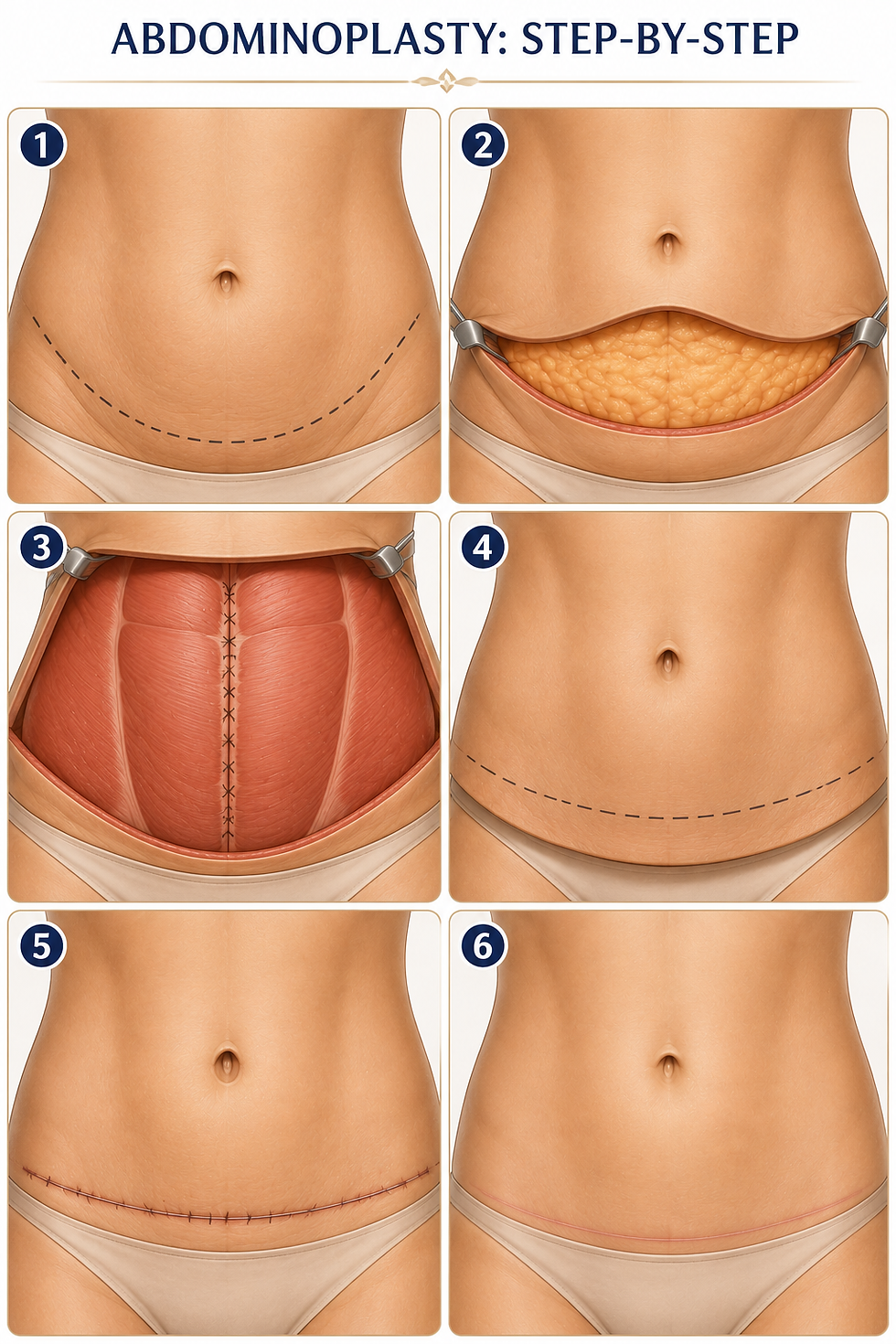
The Abdominoplasty Procedure
Abdominoplasty is generally performed under general anesthesia. The exact surgical technique and duration depend on the extent of correction required.
-
Incision: A horizontal incision is made in the lower abdomen.
-
Abdominal Wall Repair: If the abdominal muscles or their connective tissue have stretched or separated, the abdominal wall can be tightened with sutures. This is particularly relevant for patients with rectus diastasis, which commonly develops following pregnancy or significant abdominal stretching.
-
Removal of Excess Skin: The abdominal skin is mobilized, gently drawn downward, and the excess is removed. Stretch marks located within the skin being removed may also be eliminated. Stretch marks outside the excised area will generally remain, although their position may change.
-
Liposuction When Appropriate: Liposuction may be performed during the same operation to improve the transition between the abdomen, waist, and flanks.
-
Navel Repositioning: During a full abdominoplasty, the navel typically remains attached to the abdominal wall but is brought through a new opening in the repositioned skin. Care is taken to create a natural-looking position and contour.
-
Closure: The incisions are carefully closed. Surgical drains may be placed temporarily to prevent fluid accumulation, depending on the technique used.
A compression garment is generally worn during the early recovery period to support the abdomen and help manage swelling.
Recovery & Results
Swelling, bruising, tightness, and discomfort are expected during the first few weeks. Light walking is encouraged early, while strenuous exercise and heavy lifting are generally avoided for approximately six to eight weeks.
Results become more visible as swelling decreases, with the abdomen gradually appearing flatter, firmer, and more defined. Scars typically fade over time but remain permanent.
Results can be long-lasting when a stable weight is maintained, although pregnancy, significant weight changes, and aging may affect the abdominal contour.
Risks & Possible Complications
Abdominoplasty is a major surgical procedure and carries potential risks. These should be carefully reviewed before deciding to undergo surgery.
Possible complications include:
-
Bleeding or hematoma
-
Infection
-
Seroma or fluid accumulation
-
Delayed or poor wound healing
-
Changes in skin sensation or numbness
-
Unfavorable or widened scars
-
Skin contour irregularities or asymmetry
-
Blood clots
-
Skin or tissue necrosis
-
Anesthesia-related complications
-
Need for revision surgery
Smoking and nicotine use can substantially interfere with blood supply and wound healing and may increase the risk of complications. Patients should follow their surgeon's instructions regarding smoking cessation, medications, activity, and postoperative care.
Locations
Adress
4150 rue Sainte-Catherine Ouest
Suite 402 - 4e étage
Let’s Talk
info@mysite.com
Phone
514-845-9898